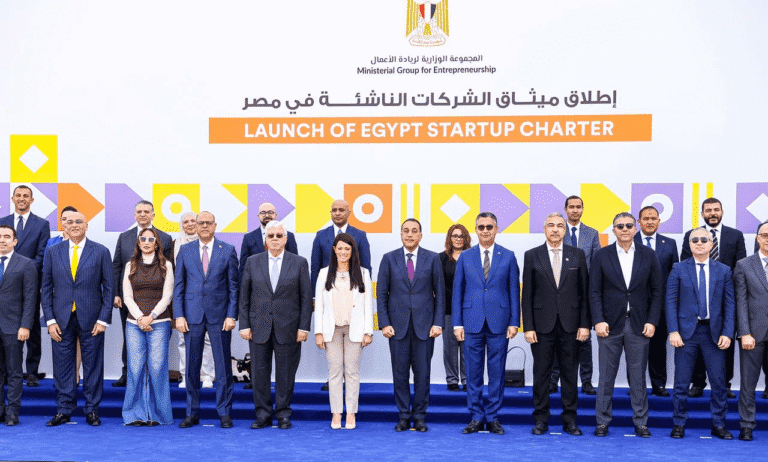
Cairo, Egypt – Prime Minister Dr. Mostafa Madbouly witnessed today the launch of the Egyptian government’s “Startup Charter,” in the presence of Dr. Rania Al-Mashat, Minister of Planning, Economic Development and International Cooperation, and Head of the Ministerial Group for Entrepreneurship. This step is the first of its kind in terms of government policies regulating the startup sector in Egypt. The launch of the Charter comes in implementation of the directives of President Abdel Fattah El-Sisi to provide various forms of support to startups, entrepreneurs, and innovators, who are considered key drivers of economic growth and job creation. The “Startup Charter” was prepared after consultations that lasted for more than a year. These consultations involved 15 national entities and more than 250 representatives from the startup and entrepreneurial community, in addition to representatives of parliamentary bodies. This was done under the auspices of the Ministerial Group for Entrepreneurship.
The Grand Egyptian Museum hosted the launch of the Charter, attended by several ministers from the cabinet, the Governor of Giza, and a number of ambassadors. Representatives from startups, venture capital funds, and other entities supporting the entrepreneurship ecosystem were also present. This coincided with the 13th edition of the RiseUp Summit for startups. The Startup Charter aims to enhance the capabilities of startups and the entrepreneurial environment in Egypt. This will contribute to achieving sustainable and accelerated economic growth based on knowledge and competitiveness, and creating decent job opportunities. Over the next five years, the Charter aims to empower approximately 5,000 startups. It also aims to contribute to providing nearly 500,000 direct and indirect job opportunities. In addition, it supports the expansion of companies into international markets and the development of local talent to reduce brain drain. Furthermore, the Charter aims to encourage venture capital and attract investments through a unified funding initiative. It connects pressing challenges in various sectors with innovative solutions offered by startups.
During the event, Dr. Rania Al-Mashat delivered a speech outlining the key features of the Charter, emphasizing that it is not merely a theoretical document but a flexible and adaptable implementation tool. This step marks the beginning of modernizing policies and legislation related to startups, aligning with technological advancements and market needs. The Minister explained that the Charter includes a unified definition of startups as newly established companies characterized by rapid growth and innovation. This allows them to benefit from government incentives and facilitations by obtaining classification certification from relevant small and medium-sized enterprises (SMEs) authorities. She added that the Charter encompasses a unified financing initiative aimed at coordinating and maximizing the impact of government funding. Efforts are underway to mobilize $1 billion in funding over five years through government resources, guarantees, and joint investments with venture capital funds and the private sector. She also noted the development of a comprehensive guide detailing the necessary government services, permits, and licenses for startups. This guide aims to streamline regulatory procedures, enhance compliance, and accelerate market entry and expansion for companies. This initiative is being undertaken in collaboration with the “Intilaq” company and UN Women.
The charter also includes a set of measures to bridge procedural gaps, streamline tax transactions, and facilitate liquidation and exit procedures. This includes the introduction of new financing mechanisms, such as crowdfunding. Studies will also be conducted to identify regulatory challenges in priority sectors and propose practical solutions. The Minister emphasized that the charter gives special attention to scale-up companies through a program designed to support their growth. This will enable them to go public or pursue strategic exits and attract international investment. This will contribute to the creation of new billion-dollar companies (“unicorns”) in the Egyptian market. The charter also includes the establishment of an observatory to monitor entrepreneurship policies. This observatory will collect and analyze data and issue periodic reports to support decision-makers, with the participation of representatives from the entrepreneurship community. Additionally, a council of experts will be established to monitor policy implementation and evaluate progress. It is worth noting that the Prime Minister issued a decree in September 2024 establishing a specialized ministerial group for entrepreneurship. This aims to strengthen the startup ecosystem and achieve sustainable economic growth based on innovation and knowledge.